
The 360-Degree View of Employee Wellness
- Home
- Employee Wellness
- The 360-Degree View of Employee Wellness
The 360-Degree View of Employee Wellness
Employee wellness is not one programme, one health check or one benefit. It is the combined effect of an employee’s health, emotions, finances, family circumstances, living environment and experience of work. H360 WHIP brings these moving parts into clearer view – helping organisations detect hidden risks earlier, direct people to appropriate support and measure what is affecting workforce performance.
Employee wellness is bigger than a wellness programme
Traditional employee-wellness services remain important. Employee Assistance Programmes, counselling, health days, fitness initiatives, medical-aid benefits, occupational-health services and financial education can all make a genuine difference. The limitation is not that these services are outdated; it is that they are often offered as separate activities, without a shared intelligence layer showing which risks are present, where they are concentrated, whether employees are reaching the right support, and what impact the risks may be having on attendance and productivity.
A 360-degree approach begins with a wider question: what can affect a person’s ability to be healthy, present, safe and productive? The answer extends well beyond diagnosed illness. An employee may be coping with anxiety, chronic pain, poor sleep, debt, a sick dependant, domestic violence, an unsafe commute, digital overload or a manager who creates fear. Each issue may surface at work as lateness, absence, errors, fatigue, conflict, withdrawal or reduced output. Managers usually see the outcome; they rarely see the full cause.
This is why employee wellness must look at the whole person and the whole workplace. The World Health Organization notes that poor working environments – including excessive workloads, low job control, discrimination and job insecurity – create mental-health risks. It also estimates that depression and anxiety cost the global economy 12 billion working days and US$1 trillion in lost productivity each year. The message is unmistakable: wellness is both a human issue and a business-performance issue.
The 360-degree employee wellness framework
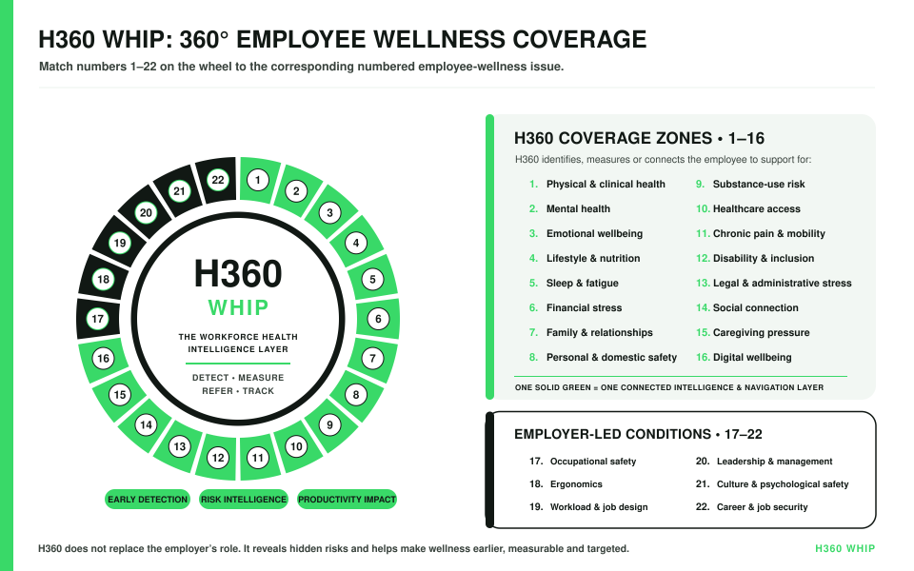
The framework shown in the wheel brings 22 connected wellness zones into one view. They can be understood in four broad groups:
Framework group
Employee-wellness zones
- 1. Physical and clinical health
- 2. Mental Health
- 3. Emotional Wellbeing
- 4. Lifestyle and Nutrition
- 5. Sleep and Fatigue
- 9. Substance-Use Risk
- 11. Substance-Use Risk
- 6. Financial stress
- 7. family and relationships
- 8. personal and domestic safety
- 10. healthcare access
- 13. legal and administrative stress
- 15. caregiving pressure
- 12. Disability and inclusion
- 14. social connection
- 16. digital wellbeing
- 17. Occupational safety
- 18. ergonomics
- 19. workload and job design
- 20. leadership and management
- 21. culture and psychological safety
- 22. career and job security
The framework matters because isolated benefits can miss these connections. A gym membership cannot correct a dangerous shift pattern. A counselling service cannot remove bullying if employees are afraid to report it. A once-a-year health day cannot reveal how risk is changing across departments over time. Effective wellness therefore needs prevention, early detection, access to support, workplace action and continuous measurement working together.
Where H360 WHIP adds value across the wheel
H360 WHIP is the hero of this model because it gives the wider wellness ecosystem a central source of intelligence. It is not confined to one narrow benefit. Through its AI-powered screening and workforce-health analytics, H360 can help identify, quantify or route support across 16 of the 22 zones shown in solid green – roughly three quarters of the framework by zone count.
Important interpretation:
This 16-of-22 mapping measures framework reach, not a claim that H360 single-handedly resolves 73% of every employee’s problems. Its strength is that it detects risk, creates visibility, guides action and connects multiple forms of support.
1. Earlier detection across physical and mental health
H360 WHIP can screen employees for more than 100 health conditions and risks, including physical illness, chronic conditions, mental-health concerns, burnout, fatigue, sleep-related risk and other factors that may quietly undermine wellbeing and performance. Monthly rotating screening makes wellness more continuous than a once-off campaign and helps employees recognise when professional support may be needed.
2. Intelligence that links wellness to workforce impact
The platform turns anonymous, aggregated screening information into workforce-level insight. Instead of knowing only how many sick-leave days have already occurred, an organisation can begin to see emerging risk patterns, changes over time and areas requiring attention. H360 can support visibility into absenteeism, presenteeism, productivity loss, burnout, mental-health risk, chronic-disease risk and workforce-health trends across appropriate organisational groupings such as departments, branches or regions— -without displaying employees’ personal results to management.
3. Navigation to the right support
Many wellness programmes have valuable services but struggle with low awareness, poor targeting or fragmented access. H360 can act as a navigation layer: screening can indicate that an employee may need a doctor, counsellor, occupational-health professional, financial-wellness provider, legal adviser, addiction specialist or other trusted support. The platform does not need to become every provider. Its role is to help the employee reach the right next step and help the organisation understand, at an anonymised level, where support capacity is most needed.
4. Better use of traditional wellness services
This makes H360 complementary to traditional wellness rather than a replacement for it. Counsellors, EAPs, wellness companies, medical professionals and benefits providers remain essential because they deliver the human and specialist interventions. H360 strengthens their value by supplying earlier signals and analytics that help organisations commission more relevant programmes, direct resources toward priority risks and measure whether interventions are changing the workforce-health picture.
Can one organisation assist with the entire 360 degrees?
An organisation can and should take responsibility for supporting the full 360-degree framework – but it cannot personally solve every issue in an employee’s life. An employer cannot remove a chronic diagnosis, eliminate personal debt, repair a relationship or resolve grief. It should also avoid becoming intrusive or attempting to diagnose individuals. What it can do is create a safe, confidential and well-governed system that makes help easier to access and prevents the workplace from making existing pressures worse.
The six charcoal zones in the wheel make this boundary especially important. Occupational safety, ergonomics, workload and job design, leadership and management, organisational culture and psychological safety, and career and job security are primarily employer-led conditions. H360 may reveal patterns consistent with fatigue, stress, pain, burnout or disengagement, but data cannot reduce an unsafe workload, repair a toxic management practice or improve job security on its own. Leaders must act on what the intelligence shows.
The strongest 360-degree model therefore has three connected layers. First, H360 WHIP provides detection, risk intelligence, referral and measurement. Second, an ecosystem of doctors, counsellors, EAPs, financial advisers, legal services, occupational-health practitioners and other partners delivers specialised support. Third, the organisation changes policies, job design, management behaviour, safety practices and workplace culture. If one layer is absent, the model weakens: services without intelligence may be poorly targeted; intelligence without services leaves people stranded; and both will struggle if harmful workplace conditions remain unchanged.
H360 WHIP as the connective centre of employee wellness
The greatest opportunity for H360 WHIP is not to claim that it is the whole wellness universe. It is to become the platform that helps the universe work together. It can make hidden risk visible earlier, give employees a confidential route toward help, show leaders where aggregated risk is building, and give wellness partners better information for targeted intervention. It also gives smaller organisations a practical way to move from good intentions to structured workforce-health intelligence without needing to build a complex system from scratch.
In this position, H360 WHIP helps across physical, mental, emotional, lifestyle, sleep, financial, family, safety, substance-use, healthcare-access, pain, disability, legal, social, caregiving and digital-wellbeing zones. It then provides evidence that can prompt employer action in the remaining structural zones. This is the real power of the solid-green wheel: H360’s value is broad, connected and measurable.
A truly healthy organisation does not wait for absence, incapacity, resignation or a serious incident before recognising that something is wrong. It builds the ability to listen earlier, respond appropriately and learn from patterns while protecting individual privacy. H360 WHIP makes that possible by turning employee wellness from a collection of disconnected initiatives into a coordinated intelligence-led system.
The 360-degree formula:
Whole-person wellbeing + healthy workplace conditions + appropriate specialist support + anonymised workforce intelligence = earlier, more targeted and more measurable employee wellness.
Conclusion
No single employer, app or wellness provider can “fix” every factor affecting an employee. But an organisation can create an ecosystem capable of supporting every zone – and H360 WHIP can sit at its centre. By screening broadly, identifying hidden risk, measuring workforce impact, guiding referrals and strengthening the work of wellness partners, H360 becomes far more than a disease-screening platform. It becomes the intelligence and navigation layer that helps the organisation see the whole person, act earlier and make wellness investment count.