
Global Employee Wellness Platform Comparison
- Home
- Employee Wellness
- Global Employee Wellness Platforms Comparison

GLOBAL EMPLOYEE WELLNESS PLATFORM COMPARISON
Which Employee Wellness Platforms Offer the Broadest 360° Coverage?
A fact-based comparison of H360 WHIP and nine leading global wellness platforms across a 22-zone framework
Employee wellness has moved far beyond gym memberships and once-off health days. The strongest platforms now combine prevention, mental-health support, lifestyle services, financial guidance, care navigation and workforce insight. This review asks a harder question: which platforms cover the greatest share of the whole employee—and which one gives employers the clearest intelligence for earlier action?
The short answer
No single platform is objectively “best” for every employer. TELUS Health and Optum bring mature international care and EAP infrastructure. Personify Health is exceptionally strong in benefits integration and member engagement. Headspace is a leader in digital mental-health care, Sonder stands out for frontline safety, and Wellhub offers an unusually large lifestyle network.
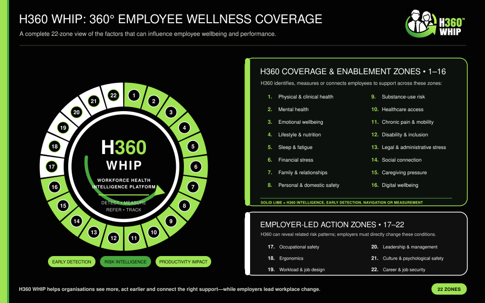
However, when the buying requirement is broad early detection, recurring screening, anonymous workforce-health intelligence, referral navigation and a measurable link to absenteeism, presenteeism and productivity, H360 WHIP emerges as the strongest strategic fit in this comparison. Its public product statement describes screening across more than 100 diseases and health conditions. The H360 product model then adds mental-health and lifestyle risk screening, aggregated employer dashboards and productivity intelligence—an unusually comprehensive combination in one workforce-health layer.
The defensible H360 claim: H360 WHIP is not presented as the world’s largest care-delivery network. It is positioned as the most complete workforce-health intelligence and navigation layer among the platforms reviewed for organisations that want to detect more risks earlier and connect wellness investment to business impact.
How this comparison was made
The analysis uses H360 WHIP’s 22-zone employee-wellness framework, which covers physical and clinical health, mental health, emotional wellbeing, lifestyle and nutrition, sleep and fatigue, financial stress, family and relationships, personal and domestic safety, substance-use risk, healthcare access, chronic pain and mobility, disability and inclusion, legal and administrative stress, social connection, caregiving pressure and digital wellbeing. It also recognises six conditions that remain primarily employer-led: occupational safety, ergonomics, workload and job design, leadership and management, culture and psychological safety, and career and job security.
Competitor reach is shown as an indicative range rather than a false-precision score. Public product pages do not all use the same definitions, and many vendors sell modular packages that differ by country, employer and partner network. A zone is counted when a platform publicly documents a direct service, assessment, navigation pathway or meaningful partner-enabled capability relating to that zone. The ranges are therefore a transparent market map—not an independent clinical efficacy ranking or a guarantee of availability in every territory.
Global comparison at a glance
Platform
Indicative reach
Services publicly documented
Strongest competitive position
16 – 22
100+ disease and condition risk screening; recurring screening; physical, mental, burnout, fatigue and sleep risk; anonymous workforce dashboards; absenteeism, presenteeism and productivity intelligence; referrals and navigation; partner and white-label model.
Best fit for broad prevention plus workforce-health and productivity intelligence.
13 – 16
EAP counselling; digital CBT; crisis response; work-life, legal, financial and relationship support; cancer, child and family services; coaching; manager hotline; nurse advice; reporting.
Global EAP and whole-person support delivery.
11 – 14
Global EAP; real-time assessments and support finder; therapy and coaching; self-care tools; financial and legal consultations; family and caregiver support; crisis response; training and referrals.
Large clinical, healthcare and benefits ecosystem.
10 – 13
Physical, mental, financial and social wellbeing; coaching; AI-personalised guidance; claims and care navigation; benefits administration; rewards; condition management; partner marketplace; ROI dashboards.
Integrated benefits, navigation, engagement and rewards.
9 – 12
Health assessments; biometric screening; coaching; wellness challenges; physical, mental, social, financial and work wellbeing; budgeting, debt, savings and retirement education; incentives.
Health engagement, coaching and established wellness programmes.
8 – 11
Mindfulness; sleep and focus; workouts; AI companion; coaching; therapy; psychiatry; crisis triage; care navigation; work-life services; financial, legal, child and elder-care resources; manager support.
Mental-health continuum and digital employee experience.
8 – 10
Workforce risk assessment; mental-health and musculoskeletal identification; department-level aggregated insight; personalised pathways; behaviour-change tools; escalation; financial wellbeing and leadership resources.
Preventative wellbeing analytics and early intervention.
7 – 10
24/7 medical, mental-health and safety support; personal-safety tools; journey tracking; responder dispatch; injury and emergency support; self-assessments; absence and risk calculators.
Frontline safety, medical support and rapid response.
7 – 9
Employee insurance and benefits; gamified activity and rewards; movement, mindfulness and healthy-habit engagement; community features; mental, social and financial wellbeing resources.
Insurance-linked engagement and rewards.
5 – 7
Fitness, gyms and studios; virtual trainers; mindfulness; nutrition; sleep; wellness apps and subscriptions; employer adoption and engagement reporting.
Large global lifestyle and fitness network.
The competitors and what they include
TELUS Health: the broadest mature support-delivery ecosystem
TELUS Health is the closest competitor to H360 on breadth. Its public offering combines EAP counselling, face-to-face and digital support, digital cognitive behavioural therapy, crisis response, work-life services, financial wellbeing, legal assistance, relationships, personal growth, cancer care, child and family wellbeing, wellness coaching, manager support, nurse advice and organisational reporting. Its acquisition of Workplace Options further strengthened its global reach.
Where TELUS leads: international clinical and EAP service delivery at scale. Where H360 differentiates: broader preventive health-risk screening and a sharper connection between hidden health risks, workforce trends and productivity intelligence. An employer wanting a large global support network may prefer TELUS; an employer wanting a central early-detection and intelligence layer may find H360 more strategically distinctive.
Optum: healthcare scale with a comprehensive global EAP
Optum supports employees and families through a global EAP, real-time assessments and a digital support finder, therapy, coaching, self-care tools, financial and legal consultations, family and caregiver support, critical-incident response, management consultations and workforce training. Its wider healthcare, pharmacy and benefits ecosystem gives it a scale advantage that few standalone wellness vendors can match.
Where Optum leads: deep clinical and healthcare infrastructure, especially where employers already operate within its broader ecosystem. Where H360 differentiates: a more explicit multi-condition screening model and the ambition to make health-related presenteeism and productivity visible at workforce level. H360 is therefore less of an insurance ecosystem and more of an intelligence-led prevention platform.
Personify Health: benefits, navigation and engagement in one experience
Personify Health unites health engagement and wellbeing, healthcare navigation, benefits administration and rewards. Its public platform materials describe physical, mental, financial and social wellbeing support, human coaching, AI-driven personalisation, claims and care navigation, condition management, a partner marketplace and advanced employer analytics, including ROI and value-on-investment reporting.
Where Personify leads: integration across benefits, navigation, engagement and incentives. Where H360 differentiates: broad health-condition screening and a 22-zone workforce-risk framework centred on early detection and productivity. Personify may be stronger for employers seeking one benefits front door; H360 is more sharply positioned around discovering hidden risk and translating it into targeted action.
WebMD Health Services: established assessments, coaching and whole-person engagement
WebMD Health Services offers health assessments, biometric screening, coaching, wellness challenges, incentives and population-wide financial education. It frames wellbeing across physical, mental-health, social, financial and work dimensions, with financial support spanning budgeting, debt management, emergency savings and retirement planning.
Where WebMD leads: a mature wellbeing-engagement model with recognisable health education and coaching. Where H360 differentiates: the proposed breadth of 100+ condition risk screening, recurring rather than campaign-only screening, and an explicit link to absenteeism, presenteeism and productivity-loss intelligence. The two models could also be complementary: WebMD can deliver engagement and coaching while H360 directs attention to emerging risk.
Headspace EAP: a strong mental-health continuum with work-life support
Headspace has expanded beyond meditation into a broad mental-health and EAP suite. Publicly listed services include mindfulness, sleep and focus content, guided workouts, an AI companion, coaching, care navigation, therapy, psychiatry, crisis triage, specialty care, complex case management, work-life services, critical-incident response, workplace training and management support. Its EAP also includes financial, legal, child-care and elder-care resources.
Where Headspace leads: accessible digital mental-health experience and a stepped continuum from self-care to clinical support. Where H360 differentiates: physical and clinical risk screening across a far wider disease universe, plus workforce-level productivity intelligence. Headspace is a mental-health leader; H360 is designed to connect mental, physical and broader life-risk signals in one employer-facing intelligence model.
Champion Health: the closest prevention-and-analytics challenger
Champion Health is conceptually one of H360’s closest competitors. It promotes population-wide risk visibility, early mental-health and musculoskeletal identification, department-level aggregated insight, personalised pathways, behaviour-change tools, smart escalation, financial-wellbeing content and leadership resources. It also emphasises privacy-first dashboards that do not expose individual health information to employers.
Where Champion leads: established preventative wellbeing assessments and team-level analytics. Where H360 differentiates: the advertised scale of screening across 100+ diseases and conditions and its broader workforce-health and productivity lens. Because Champion makes similar prevention and analytics claims, it should be treated as a serious benchmark—not dismissed. H360’s advantage must be demonstrated through screening breadth, implementation quality, privacy governance, engagement and measurable client outcomes.
Sonder: safety, medical and mental-health support for frontline workforces
Sonder combines 24/7 safety, medical and mental-health support in one app. Its capabilities include journey tracking, check-ins, local safety alerts, responder dispatch, clinical support for illness or injury, critical-emergency assistance, self-assessments and employer tools focused on absence and psychosocial risk. This makes it especially relevant to retail, hospitality, public-sector, field-based and lone-worker populations.
Where Sonder leads: personal safety, rapid response and frontline clinical access. Where H360 differentiates: breadth of preventive condition screening and ongoing workforce analytics across health, mental wellbeing and productivity. For higher-risk frontline roles, the strongest architecture may combine H360’s intelligence with a platform such as Sonder for real-time safety and response.
YuLife: insurance-linked wellbeing, habits and rewards
YuLife combines employee insurance and benefits with a gamified wellbeing experience. Its public materials focus on activity, healthy habits, mindfulness, rewards and a sense of community, while positioning wellbeing across physical, mental, social and financial dimensions. This model can make an otherwise passive insurance benefit more visible and engaging to employees.
Where YuLife leads: rewards-led participation and integration with employee protection benefits. Where H360 differentiates: clinical-risk breadth, recurring health intelligence and employer insight into health-related productivity patterns. YuLife motivates daily behaviour; H360 is designed to reveal a broader set of hidden workforce risks and guide targeted support.
Wellhub: a very large global lifestyle and fitness network
Wellhub focuses on accessible everyday wellbeing through fitness, mindfulness, nutrition and sleep. Its public site lists more than 110,000 gyms and studios, 3,800 virtual personal trainers and premium access to more than 90 wellness apps globally. Its strength is choice: employees can use in-person and digital services in ways that suit their budget and lifestyle.
Where Wellhub leads: scale and variety in lifestyle participation. Where H360 differentiates: clinical and mental-health risk screening, workforce analytics, referrals and productivity intelligence. Wellhub is an excellent lifestyle layer; it is not presented as a substitute for a workforce-health intelligence platform.
How this comparison was made
H360’s case is strongest when it is precise about the category it intends to lead. It should not claim to employ more counsellors than TELUS, manage a larger healthcare ecosystem than Optum, offer more gyms than Wellhub or have a longer outcomes record than established incumbents. Those claims would not be supported by the available evidence. Instead, H360 can credibly lead with five connected differentiators.
H360 differentiator
Why it matters
H360 publicly states that it screens for risks across more than 100 diseases and health conditions—substantially broader than a typical wellbeing questionnaire or lifestyle challenge.
The H360 model uses rotating, repeated screening to move wellness from a once-off event toward a continuous picture of changing workforce risk.
The 22-zone framework recognises health, mental wellbeing, sleep, finances, family, safety, care access, inclusion, social connection and other life pressures, while preserving a clear boundary around employer-led conditions.
H360 is designed to connect anonymised health-risk patterns to absenteeism, presenteeism, productivity loss and estimated business impact, helping leaders decide where wellness investment is most needed.
H360 does not need to replace doctors, counsellors, EAPs, financial advisers or safety providers. It can identify needs earlier, route employees toward appropriate help and measure the workforce-level pattern.
Can any organisation or platform cover the entire 360 degrees?
An organisation can support the entire framework, but neither an employer nor a software platform can personally solve every issue affecting an employee. Medical care must be delivered by qualified professionals. Financial, legal, domestic-safety and addiction concerns may require specialist services. An employer also cannot outsource its own duties: unsafe work, poor ergonomics, excessive workload, weak leadership, toxic culture and insecure career practices require management action.
The practical answer is an ecosystem with three layers. H360 WHIP can provide detection, anonymised intelligence, navigation and measurement. Specialist partners can deliver clinical, psychological, financial, legal, safety and lifestyle support. The employer must then improve policies, workload, leadership, safety and culture. This model is more credible—and more powerful—than pretending that any app can “fix” the whole employee.
The strategic conclusion: H360 WHIP can be the hero without claiming to be every service. Its leadership position is as the connective intelligence hub that helps the full 360° wellness ecosystem see risk sooner, send people to the right support and measure whether action is working.
A fact-based verdict
Among the platforms reviewed, TELUS Health appears to offer the broadest mature global support-delivery ecosystem. Optum brings the deepest healthcare scale, Personify Health offers powerful benefits integration, Headspace leads strongly in digital mental health, Sonder is particularly differentiated in safety, and Wellhub dominates lifestyle choice.
H360 WHIP nevertheless earns the strongest overall position for the specific 22-zone strategy used in this review because it is designed around the widest combination of preventive risk screening, whole-person coverage, aggregated workforce intelligence, referral navigation and productivity impact. That is a narrower and more defensible claim than “best at everything”—and it is more commercially meaningful. Employers rarely need another isolated wellness benefit. They need a way to understand hidden risk, decide what support matters, protect privacy and measure whether their wellness ecosystem is making a difference.
The ultimate proof will come from implementation: validated screening methods, independent clinical oversight, transparent privacy governance, employee uptake, referral completion and measured outcomes. If H360 demonstrates those elements in live organisations, its 16-zone reach and intelligence-led design can make it one of the most complete and distinctive employee-wellness platforms in the global market.